Oct 28, 2026Buying Guides
Crew Neck vs V-Neck: Engineering an Open Neckline
Compare crew neck and V-neck knitwear construction. Learn how collar drop, rib band tension, and apex reinforcement shape fit and durability in sample runs.
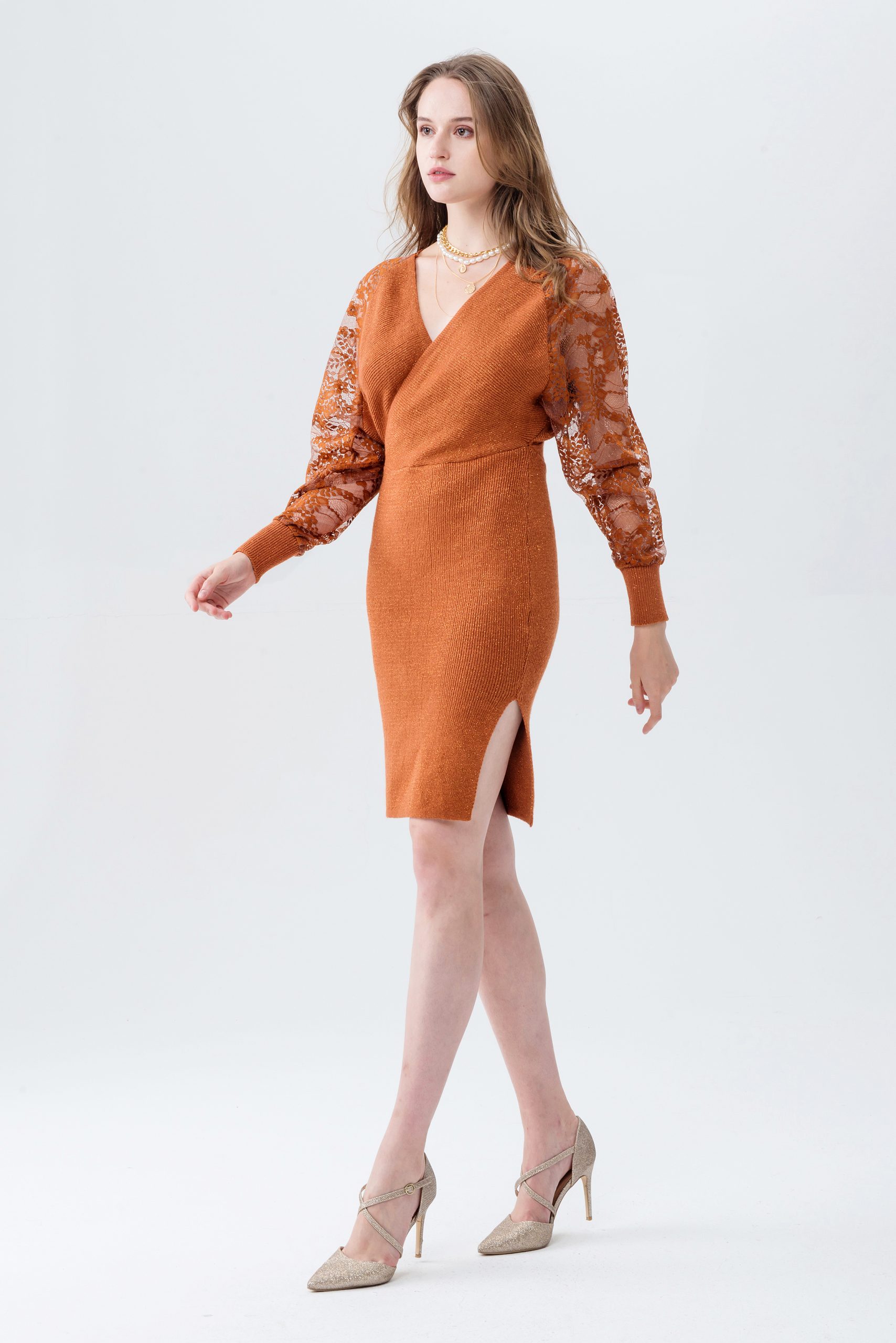
A pullover returns from its first wash with a collar that has lost its snap and a V that no longer sits centered. That failure is engineered upstream: an open neckline must withstand stretching during dressing and recover after washing. Both necklines appear across our live range of 25 styles, from crew pullovers to V-neck knit dresses.
1. The Neckline Frames the Whole Garment
The collar opening serves as the primary visual anchor of a sweater while functioning as a critical mechanical junction. Unlike closed collars supported by an upright knitted tube, an open neckline suspends across the collarbones and chest, anchored by shoulder seams and collar trim elasticity.
Every time a pullover passes over the head, the opening expands radially. Once released, the knit loops must contract without sagging or rippling. Because a crew collar traces a continuous curve while a V-neck introduces an angular vertex, each requires distinct engineering parameters.
2. Crew Neck: Width, Depth, and Circular Balance
A crew neck defines an unbroken circular curve around the neck base, requiring coordination between circumference, drop, and rim density.
Drop depth and opening proportion: Front neck drop dictates collar placement. If a brief calls for a shallow standalone crew, a drop of two to three inches measured from the shoulder point keeps the fit clean, while deeper curves accommodate layered shirts; the back stays subtle at half an inch to one inch, anchoring the rim across the spine.
Collar band width and knitting tension: The width of the rib trim governs the inward contracting force applied to the garment. Wider trims require tighter knitting tension to keep the collar edge from rolling outward, while narrower bands require balanced stitch density to rest flat. Workshop technicians adjust machine tension specifically to support the curved neckline contour.

Dial linking alignment: Attaching the collar to the body requires exact loop-to-loop linking. If linking tension pulls unevenly around the curve, the collar ripples. Balanced needle counts across panels keep the circular band flat and symmetrical.
3. V-Neck: Depth, Apex Reinforcement, and Symmetry
A V-neck replaces the smooth curve of a crew with two converging diagonal edges meeting at a lower vertex, introducing localized mechanical tension.
Opening depth and diagonal pull: Whether a V sits high on the chest or drops toward mid-chest, deeper openings increase lateral pull along the diagonal edges, and the knit structure along each edge must support that tension without gaping across the chest.
Apex construction and seam stabilization: The base of the V is among the most vulnerable points on the garment. Designers specify an overlapped join or a mitered center seam linked loop by loop. Technicians reinforce the inner vertex with concealed hand stitching or bar-tack stitches to disperse pulling forces and protect against splitting.
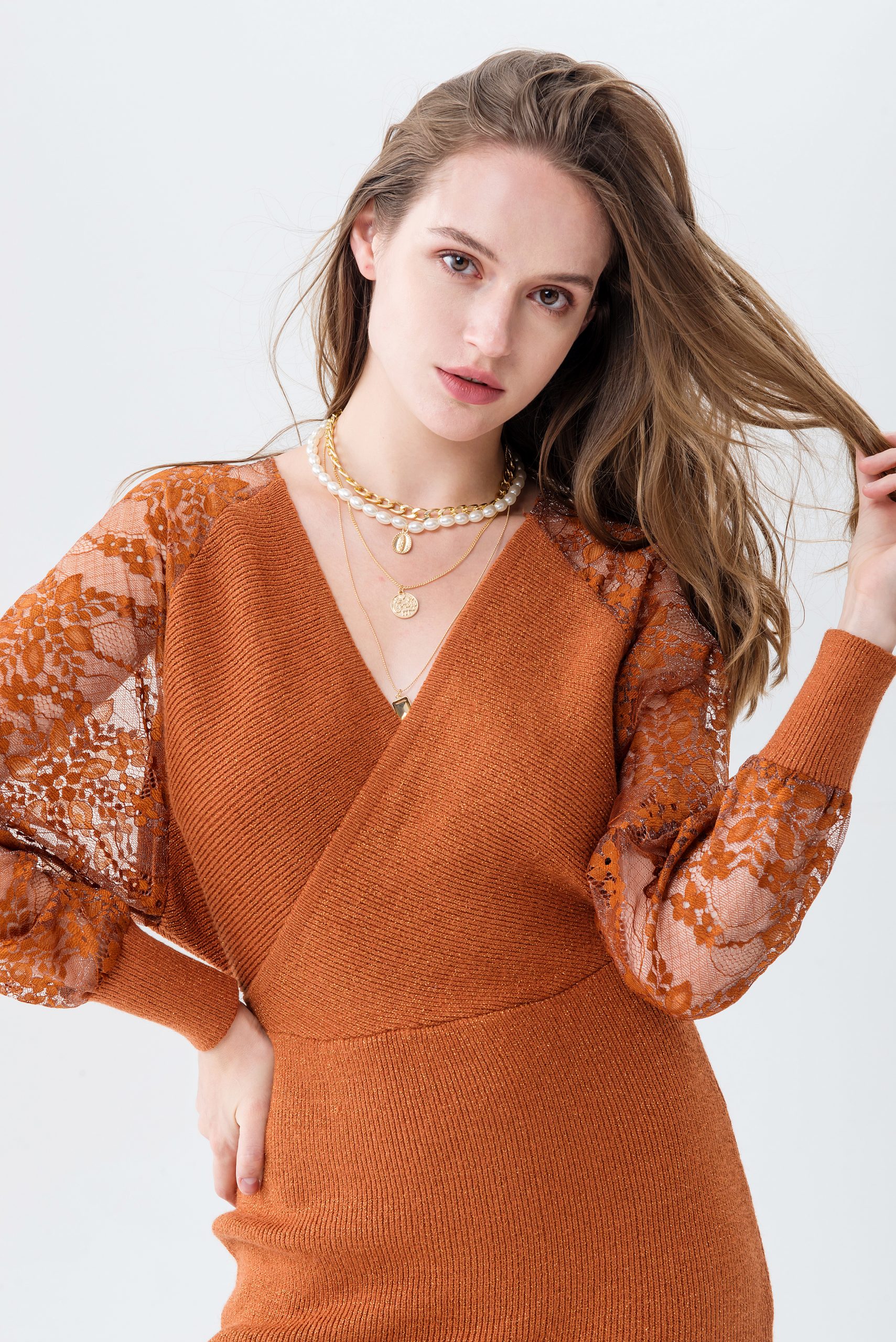
Bilateral edge symmetry: Identical stitch counts and yarn tension along both diagonal bands are essential for symmetry. If one side carries looser tension or unequal linking stretch, the lower vertex drifts away from the center line, distorting the front panel.
4. Preserving the Geometry of an Open Collar
Open collars experience ongoing wear from movement, layering, and laundering. Addressing these stresses during development helps sweaters retain their shape.
Elastic recovery and loop resilience: Workshops can integrate fine elastane filament alongside primary yarn along collar trim edges. This addition provides supplementary spring-back recovery, helping the opening snap back after repeated dressing without distorting surrounding knit loops.
Care practices and gravity effects: Wet knitwear absorbs moisture during washing. If an open-neck sweater dries on a hanger, gravity stretches the collar opening. Recommending flat drying and folded storage helps wearers preserve original neckline dimensions.
Layering friction and edge wear: Collars worn beneath structured coats rub against outer lapels. Specifying compact linking and balanced yarn twists reduces surface fuzzing along exposed neck edges.
5. Validating Neckline Execution Through Sampling
Evaluating prototype samples under realistic physical conditions highlights potential collar defects before committing to production.
Stretch and recovery testing: Technicians verify how easily the collar opening stretches over standard head dimensions. The opening should expand smoothly without breaking linking threads, then return immediately to its specified flat width.
Apex alignment and wash testing: Prototypes undergo dimensional stability washing to verify that collar trims do not pucker and the V-point remains centered. Measuring collar dimensions before and after laundering confirms that tension settings stay within tolerance.
Working from Guangzhou since 2018, our team has built crew and V necklines for European and North American labels across OEM and ODM development. Minimum orders of 50 pieces per color per style and sampling in 5-7 days let brands evaluate collar stretch, apex symmetry, and recovery in hand. Contact our workshop team to review your neckline specifications and request a confidential quote.