Oct 28, 2026Buying Guides
Printing on Knitwear: What Works on Knitted Fabric
Learn how printing on knitwear works without cracking or distortion. Discover how gauge, stitch density, ink choice, and sampling keep graphic artwork clean.

A sample strike-off comes back with cracked ink and wobbly lines, and artwork that read clean on woven fabric somehow fails on a sweater. Knitted fabric is an elastic grid of interlocking loops that stretch with movement. While knitting a pattern into the fabric creates a single unified structure, surface printing places artwork directly on top of flexible stitches. When brands print graphics without accounting for stitch geometry, the result is often distorted lines or ink that fractures under tension. Successful printing balances stitch density, graphic scale, and ink chemistry before production begins.
1. Knitted Fabric Is Not a Flat Canvas
Standard screen printing treats fabric as a smooth two-dimensional plane. A sweater panel has three-dimensional texture shaped by curved yarn loops, microscopic valleys between wales, and natural surface fuzz.
Liquid ink must bridge across loops rather than settling on a sealed surface. Applied too sparingly, ink sinks into valleys, breaking fine lines into jagged steps. Flooded into a heavy coat, it forms a rigid shell that splits along course lines as soon as the garment stretches.
2. Gauge Decides What a Print Can Carry
Machine gauge dictates canvas resolution. Fine needle beds pack tiny stitches closely together, while coarse beds create wide, dimensional loops with visible space between strands.
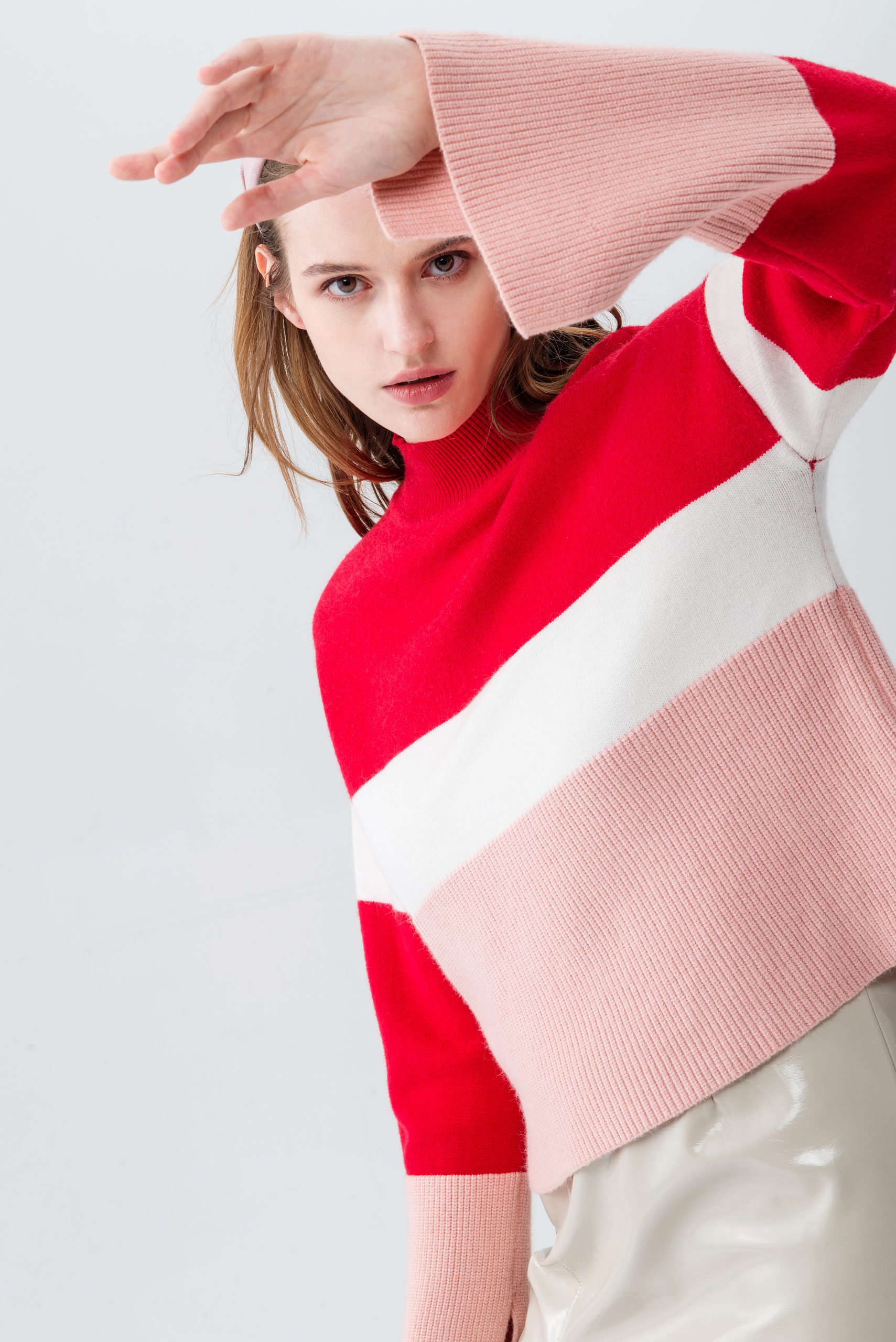
Fine gauge for detailed artwork: Panels knitted on 12GG or 14GG beds present a smooth ground that supports crisp outlines. Our live range includes a printed knit style, and the smooth fine-gauge pullovers beside it show how cleanly a flat face carries fine detail.
Chunky gauge for bold motifs: On chunky 3GG or 7GG panels, large loops distort delicate linework as strokes drop into deep troughs. Chunky knits require simplified silhouettes and broad color fields that remain legible over textured stitches.
Open stitch limits: Loose tensions and open pointelle structures lack the surface continuity needed to carry ink. When loops slide freely, printed graphics distort across shifting gaps.
3. Ink Layers and Stretch
The main mechanical tension sits between ink elasticity and fabric movement. Sweaters stretch during wear, but dried ink films possess limited elongation. Selecting the ink method balances visual density against wearable drape.
Soft-hand formulations: Water-based and discharge methods bond with fibers rather than building a heavy coat. Smooth yarn spins with minimal surface hair accept these inks cleanly, keeping the knit soft while preserving natural stretch.

Surface ink films: Heavier inks yield opaque color on dark knits, but thick coats dry into rubbery layers. Stretch additives blended into these inks improve flexibility and reduce cracking risks, while designers keep solid print coverage compact.
Printing panels before assembly: Printing assembled sweaters causes uneven squeegee pressure near seams. Printing flat panels before final dial linking allows uniform ink penetration and accurate alignment across the body.
4. Artwork Rules for Knit Surfaces
Preparing digital graphics for knitwear requires adjusting artwork for loop behavior. Graphics imported directly from paper or T-shirt templates often fail during sample strikes unless line weights and negative spaces are calibrated.
Stroke width and spacing: Delicate hairlines drop into stitch valleys. Increasing stroke thickness helps ink bridge across adjacent loops. Expanding negative space between shapes also keeps spreading ink from closing fine openings.
Placement relative to wear: Sweaters pull hardest at the underarms and side seams, where body movement concentrates strain. Centering prints on the mid-chest, away from those high-stretch zones, limits film fatigue; friction there is lower too, so surface ink abrades less over repeated wear.
Blueprint coordination: Tech packs must fix graphic coordinates relative to neck drops and seam allowances before knitting. Coordinating artwork on panel blueprints keeps graphics centered without distorting collar trims.
5. Verifying a Print Through Sampling
Because yarn tension and ink layers interact unpredictably, prototyping is the essential proving ground. Physical sample rounds verify whether graphics maintain visual fidelity and flexibility under real handling.
Stretch testing: The sampling team manually pulls the printed sample across its width to evaluate ink elasticity. A viable strike-off stretches alongside moving stitches without peeling or developing hairline cracks.
Wash trials and strike-through: Laundering prototypes tests ink adhesion and reveals wash bleeding. The interior is checked as well, confirming fluid ink has not struck through loops to create rough spots against the skin.
Founded in 2018 in Guangzhou, Imorna supports European and North American fashion brands with OEM and ODM knitwear manufacturing. Our partner workshops run 3GG, 7GG, 12GG, and 14GG flat knitting machines, supported by development sampling and pre-shipment inspection reports. We protect confidential designs with minimum order quantities of 50 pieces per color per style, alongside sampling in 5 to 7 days. Contact our team to review your graphic artwork and evaluate print options on your next knitwear sample.